Sunday, September 29, 2019


Messy Democratic Politics is as High-Minded as it Gets

Today’s ABJ ran the commentary reprinted below in full. I agree with the central point here: we must not let our political struggles treat impeachment as an everyday strategy.

But I wonder about the section in bold, analyzing Pelosi’s strategic thinking. It suggests she was either high-minded or ‘just political.’ It is possible my response is just a quibble, but I wanted to unpack it nonetheless.

Politics is the mechanism we use to try to solve problems and choosing a democratic system is a high-minded choice. Contrasting the thoroughly expected messiness that results with principle-based decision making muddies our thinking.

This common contrast, doing the right thing or doing ‘just politics,’ is more likely meant to highlight a tension between ends and means. But as we learned from Gandhi and others we only get to choose our means and then in concert with others watch as our ends unfold, so we want our means to reflect our end, we want to be the change, to enact the end we seek. So, seeing this as an end/means tension ought to highlight the high-mindedness of the attention to 'mere means.' But an end/means frame also distracts here.

We would be better off thinking about this as a tension between politics that strengthens democracy and politics that strengthens party (or group or sect or region or demographic or class) even if it means weakening democracy.

One way to think about this is the tension between democratic politics (problem solving together) and partisanship (winning elections to win the power to identify problems and solutions).

And partisanship itself should be seen on a continuum. There is nothing low-minded about trying to win an election or confirmation or passage of legislation. If the last three years has taught us anything it is this.

So, even partisanship can be high-minded, in the same way a skilled defense attorney is necessary for the rule of law to mean anything.

But partisanship can also be low-minded, as we have seen in Mitch McConnell, putting party before community and, in particular, before respect for the rules of the game that strong democracy and resilient community life depend on. 

Does this help us understand Pelosi’s strategic choices better? 

Is a calculation to forgo a battle because one expects to lose the opposite of high-minded? If (as the commentary below warns) the decision to go forward results in amplifying divisions, civil war, and the collapse of the republic…will we look back on her hesitation as merely a pause for low-minded ‘political expediency?’

If choosing impeachment results in rioting and violence, marshal law or worse, will we look back on Pelosi’s calculations as merely wafting in ‘shifting political winds?’ Those 'political winds' are an imperfect proxy for the sentiments of voters.

The commentary below begins to recognize the error of its framing when it notes that Pelosi is wrestling with a paradox, which is often the nature of 'just politics' when the questions are particularly gnarly.

It is a paradox. We need to find a solution to this problem that will not further divide us (or might even unite most of us). But that requires the solution to be seen as high-minded, based on respect for the rules of the game, and consistent with our (a bit tattered today) shared values.

A solution that is seen as putting party before nation style partisanship will not accomplish this. Recognizing the sentiments of voters in swing districts, vote counting in your caucus, considering how the Senate might respond are all ways to weigh the degree to which any solution can be persuasively presented as an effort to solve problems together rather than merely more of the same putting party first.

This is doing politics, tacking with shifting winds, weighing the expediency and likelihood of success of various approaches, and it could also be high-minded. It is certainly not low-minded by definition.

As the quote from Hamilton makes clear below, our framers expected that ‘doing politics’ would mean contentious efforts to address tough questions together. They knew, from experience, that the tougher the questions the more ‘doing politics’ will “agitate the passions of the whole community” and divide us into camps holding competing perspectives on the tough questions at hand. 

That is not ‘just politics.’ That is democratic politics and nothing is more high-minded.


On June 25, 1973, John Dean said the words that changed everything:

“I began by telling the president that there was a cancer growing on the presidency and if the cancer was not removed that the president himself would be killed by it.”

Testifying before the Senate Watergate Committee, the former White House counsel for President Richard Nixon tied the administration for the first time to a cover-up and obstruction of justice. Dean’s words that day put the Nixon presidency on a path that led inexorably to his resignation on Aug. 9, 1974.
Great change, as with Nixon’s downfall, is always impossible right up until the moment it becomes inevitable.

The presidency of Donald Trump intersected with its moment in history last week.

Not that Trump will resign from office or be removed; his fate is still to be determined by future events. But with the burgeoning Ukraine whistleblower scandal gaining strength and extending its tentacles across the executive branch, his impeachment by the U.S. House of Representatives is now certain.
It is the logical final step in dealing with any president who openly flaunts his misuse of office.

Alexander Hamilton wrote in Federalist Paper No. 65 of impeachment being for “the misconduct of public men, or, in other words, from the abuse or violation of some public trust,” a standard under which Trump most certainly qualifies.

From his open defiance of the Constitution’s emoluments clause forbidding government employees from receiving gifts or profit from foreign states, to his 10 acts of obstruction of justice well documented in the Mueller Report, Trump’s unique unfitness for high office has long been apparent. We will be working to repair the incalculable and ongoing damage done by his constant attacks on the norms and conventions of our system of government far into the future.

But until details of Trump’s July 25 phone call with Ukraine President Volodymyr Zelenskiy, referenced in a whistleblower complaint previously suppressed by the administration, began to leak, it seemed assured Trump would not face impeachment in the House before the 2020 election. Speaker Nancy Pelosi had been simply unwilling to take the action her constitutional office requires.

Why?

To Pelosi’s critics on the left, her outright refusal to consider Trump’s impeachment reeked of political expediency, the speaker failing to act in order to protect her centrist-district members from a difficult vote. And now, as the thinking goes, her announcement Tuesday of a formal impeachment inquiry merely signals a change to mirror the shifting political winds.

But what if her thinking has been more high-minded?
From its inception, impeachment has been something of a paradox — a political solution that in order to be considered legitimate must be seen as being above politics, based on higher principles.

“They are of a nature which may with peculiar propriety be denominated POLITICAL, as they relate chiefly to injuries done immediately to the society itself,” Hamilton wrote. “The prosecution of them, for this reason, will seldom fail to agitate the passions of the whole community, and to divide it into parties more or less friendly or inimical to the accused.”

That is the greatest risk Trump’s impeachment and subsequent trial in the U.S. Senate will pose, that it will set off an escalating series of partisan battles exacerbated by our hyper-partisan society. The American experiment will not long survive if presidential impeachment becomes a frequent feature of our political landscape, especially if partisanship dictates the outcome.

Politicians of both major parties need to be mindful of that risk, and guard against it by holding all presidents to the same high standards. 

Impeachment is not precision surgery to remove a cancer from the presidency. It is chemotherapy introduced into the body politic, with all the attendant risks associated with seeking a necessary cure.

It is a weapon of last resort. It must not be a partisan cudgel.


Sunday, August 25, 2019


The go-it-alone-president now has nowhere to turn
Reading together an analysis from AP and a George Will editorial from today’s news we can see that a president who believes he knows more than anyone, but acts on an economic theory that ‘makes up in brevity what it lacks in nuance’ to launch two ill-advised wars can now be seen as nearly single-handedly sparking a global recession. 


Both articles were reprinted in today’s ABJ—great local paper.

His stubborn insistence that a trade war with China and a war against our NATO allies would make us safer and more prosperous has, of course, turned out to be monumentally wrong-headed.

His trade war has already cost American taxpayers $20 billion, hurting American farmers and agricultural sector companies even more, resulting in an ‘Trump import tax’ of $1000 on every American family…and is now escalating to the point where business leaders fear a worldwide recession.

And he is now at the G7 seeking a united front from our long-time NATO allies…yes, those allies he has ridiculed and insulted consistently for the past two years.

The Trump import tax & ally insult strategy is playing out as we now approach a serious economic downturn that will further hurt American families. Everyone other than Trump saw this coming. This is a time to unite behind whomever the Democratic nominee is an punish the Republican Party for enabling this disaster by putting party before people.

With nowhere to turn the president is threatening to compel US companies to leave China (talk about the ugly side of socialism) and ratcheting up his anti-immigrant rhetoric. He and his enablers have already repeatedly demonstrated they will do anything to win an election, even it means hurting American families. So, let’s hope his juvenile desperation does not turn into putting our young men and women into harms way in a nuclear confrontation with North Korea or Iran.

Below is the full text of the AP story and the Will editorial.

Confronting Consequences. AP

BIARRITZ, France (AP) — Under the threatening clouds of a global economic slowdown, President Donald Trump is confronting the consequences of his preference to go it alone, with low expectations that the leaders of the richest democracies can make substantive progress on an array of issues at their summit in France.

The meeting of the Group of Seven nations — Britain, Canada, France, Germany, Italy, Japan and the U.S. — in the beach resort town of Biarritz comes at one of the most unpredictable moments in Trump’s presidency, when his public comments and decision-making increasingly have seemed erratic and acerbic of late.

Trump, who arrived Saturday, and his counterparts are facing mounting anxiety over the state of the world economy and new tension on trade, Iran and Russia . Trump, growing more isolated in Washington, might find a tepid reception at the summit as calls increase for cooperation and a collective response to address the financial downturn. White House aides claimed he engineered a late change to the summit agenda, requesting a working session on economic issues.

The economic warning signs, along with Chinese’s aggressive use of tariffs on U.S. goods, are raising the pressure on Trump and his reelection effort. He intends to push allies at the summit to act to promote growth.

But Trump’s credibility as a cheerleader for multilateralism is in doubt, given that he has spent the first 2½ years in office promoting an “America First” foreign policy that relying on protectionist measures. Traditional American allies have come to expect the unexpected from this White House; increasingly they are looking elsewhere for leadership.

Only hours before his arrival in Biarritz, Trump had threatened anew to place tariffs on French wine imports to the U.S. in a spat over France’s digital services tax; the European Union promised to retaliate. That was the backdrop for a late addition to his summit schedule — a two-hour lunch with French President Emmanuel Macron outside the opulent Hotel du Palais.

The summit host said the two men were discussing “a lot of crisis” around the world, including Libya, Iran and Russia, as well as trade policy and climate change. But he also echoed Trump’s calls for Europe to do more to address the global slowdown, including by cutting taxes. “When I look at Europe, especially, we need some new tools to relaunch our economy,” Macron said.

Trump insisted that despite tensions, he and Macron “actually have a lot in common” and a “special relationship.” In a later tweet, he said: “Big weekend with other world leaders!

Macron outlined details of a French plan to ease tensions with Iran by allowing Iran to export oil for a limited amount of time, said a French diplomat, who spoke on condition of anonymity in accordance with the presidency’s customary practices. In exchange, Iran would need to fully put in place the 2015 nuclear deal, reduce tensions in the Persian Gulf and open talks. The plan was met with a skeptical reception by Trump, and the White House paid only a cursory mention of the Gulf in its official readout of the lunch meeting.

Trade was clearly on Trump’s mind when he left for France. Trump declared that U.S. businesses with dealings in China are “hereby ordered” to begin moving home. It was a threat to use the emergency authority granted by a powerful, but obscure federal law intended to target rogue governments, terrorists and drug traffickers, and giving presidents wide berth in regulating international commerce during times of declared national emergencies.

It was not immediately clear how Trump could use the act to force American businesses to move their manufacturing out of China and to the U.S, and Trump’s threat appeared premature — as he has not declared an emergency with respect to China.

In recent days, Trump has sent mixed signals on a number of policy fronts. At one point, he moved to simmer the trade conflict with China in order to ease the impact on American consumers during the holiday shopping season. At another, he flip-flopped on the need for tax cuts to stimulate an economy that Trump publicly insists is rocketing.

Feeding Trump’s anxiety, aides say, is his realization that the economy — the one sturdy pillar undergirding his bid for a second term — is undeniably wobbly.

Trump planned to press leaders about what can be done to spur growth in the U.S. and abroad, as well as to open European, Japanese and Canadian markets to American manufacturers and producers. Trump has imposed or threatened to impose tariffs on all three markets in his pursuit of free, fair and reciprocal trade.

The annual G-7 summit has historically been used to highlight common ground among the world’s leading democracies. But in a bid to work around Trump’s impulsiveness, Macron has eschewed plans for a formal joint statement from this gathering.

Last year’s summit, hosted by Canadian Prime Minister Justin Trudeau, ended in acrimony when Trump felt he had been slighted by Trudeau after the president left the meeting.

Trump tweeted insults at Trudeau from aboard Air Force One as he flew to a summit with North Korea’s Kim Jong Un. Trump withdrew his signature from the statement of principles that all seven nations had agreed to.

Addressing the global slowdown isn’t the only pressing challenge that Trump has discovered requires joint action.

For more than a year, his administration has struggled with persuading European leaders to repatriate captured fighters from the Islamic State group. So far his entreaties have fallen on deaf ears.

Many of the summit proceedings will take place behind closed doors, in intimate settings designed for the leaders to develop personal relationships with one another. On Saturday night they dined at the Biarritz lighthouse, with commanding views of the Bay of Biscay.

Trump, White House aides said, was looking forward to a Sunday morning meeting with new British Prime Minister Boris Johnson , the brash pro-Brexit leader whose election he’d backed. The two spoke by phone on Friday, and Johnson said Saturday he would use the meeting to push Trump to de-escalate the American trade war with China.

Trump has scheduled individual meetings with several of his counterparts, including Macron, Trudeau, Merkel, Japanese Prime Minister Shinzo Abe and Indian Prime Minister Narendra Modi.

Other topics on the agenda will be the clashes between police and pro-democracy protesters in Hong Kong; Iran’s renewed nuclear enrichment and interference with shipping in the Strait of Hormuz; and the Islamic State prisoners currently imprisoned by American-backed Kurdish forces in Syria.

Wounded by Friendly Fire in a Trade War, George Will

Washington • In a trade war, as in a real one, people are wounded by friendly fire from their side. Consider some casualties in Donald Trump’s “easy to win” — his promise — trade war. Begin with the company whose green machines bear the name of the blacksmith who, in the 1830s in Grand Detour, Illinois, invented a self-scouring plow that could turn the Midwest’s heavy black topsoil.

Is the John Deere corporation “tired of winning,” as Trump promised that all Americans soon would be? Not exactly. The Wall Street Journal reports that U.S. farmers are purchasing fewer farm machines — Deere’s profits from this business are down 24% from a year ago — partly because farmers’ incomes have suffered as a result of the tit-for-tat trade spat that Trump started with China, which has included China canceling the purchase of almost 500,000 metric tons of soybeans. Some good news for John Deere might be ominous news for U.S. farmers: Equipment sales to Brazil and Argentina are up, perhaps partly because China has increased purchases from those nations’ farmers, who are American farmers’ competitors.

Nowadays, even sensible government actions injure some farmers. Many of them have come to depend on government's misguided mandate regarding ethanol in gasoline, and the Journal reports that 31 refineries have been given ethanol waivers from the Environmental Protection Agency. The Iowa Corn Growers Association says the exemptions could eliminate "nearly one billion bushels of corn demand." Whether ethanol would have achieved sacramental status in Washington if Iowa did not have presidential caucuses is a subject for another day.

Home Depot, the world's largest home improvement retailer (more than 2,000 stores in North America), partly blames the trade war for its lowered growth expectations. The tariffs, which The Financial Times accurately refers to as "import taxes," will, according to a JPMorgan estimate, cost the average U.S. household "around $1,000 a year." If so, this Trump tax increase — it is his alone — is more important to the average American than his (actually Congress') tax cut.

The Financial Times recalls that "hundreds of U.S. companies and trade associations said in a joint communique in June that the proposed duties would cause the loss of two million jobs and reduce U.S. economic output by 1%." The losses and reduction are related to the fact that, as Allan Golombeck of the White House Writers Group notes, "Over 60% of U.S. imports are used by businesses in their products and production processes." Hence Trump's tariffs make U.S. goods more expensive, thereby dampening U.S. consumer activity. And exacerbating trade deficits, which do not matter other than as irritants to Trump, who thinks they indicate foreigners taking advantage of Americans by selling them things they want.

Uncertainties infused into the global economy by the trade war between the world's two largest national economies probably have helped to produce a global slowdown and fears, perhaps somewhat self-fulfilling, of an approaching recession. The fourth-largest economy, that of heavily export-dependent Germany, is already shrinking. There, as The Economist reports, "interest rates are negative all the way from overnight deposits to 30-year bonds. Investors who buy and hold bonds to maturity will make a guaranteed cash loss."

This does not suggest economic health but might produce something pleasing to the president whose macroeconomic theory makes up in brevity what it lacks in nuance: "Low interest rates are good." He is forever hectoring the Federal Reserve to lower rates, which it might again do if it sees a recession tiptoeing toward us. So, a recession would be an interestingly injurious carom — a win, of a perverse sort — from his trade war.

From May 1937 to June 1938, there occurred the "recession within [the] Depression," America's third-worst 20th-century contraction. About the causes of this, as about so many economic events, intelligent and informed people disagree. However, one theory is that capital went "on strike." Rattled and exasperated by the New Dealers' regulatory fidgets, investors flinched from economic activity. If so, this episode contains a warning for protectionists who seem oblivious.

They fiddle with global supply chains, as though the world economy is a Tinkertoy that they can pull apart and reassemble with impunity. Actually, it is analogous to an Alexander Calder mobile: jiggle something here, things wiggle way over there, and there, and there. So: Tariffs on Apple (headquarters: Cupertino, California) iPhones that are made (actually, just assembled) in China might help Samsung (headquarters: near Seoul, South Korea) Galaxy phones sell in America. This is "America First" in practice.

Monday, July 29, 2019

Recent Democratic Presidents are More Fiscally Responsible
A recent tweet outlining this fact ended up in a politifact fact check story. Because some of the numbers in the original tweet were slightly off (though not off enough to change the conclusion), Politifact rated it as Mostly True. Here is the tweet, with corrected numbers based on the Politifact analysis and the link to the full Politifact story.


"Reagan took the deficit from $79 billion to $153 billion. Bush 41 took it to $255 billion. Clinton got it to zero. Bush 43 took it from zero to $1.4 trillion. Obama halved it to $584 billion. Trump’s got it back to a trillion."


https://www.politifact.com/truth-o-meter/statements/2019/jul/29/tweets/republican-presidents-democrats-contribute-deficit/?fbclid=IwAR3dle30Vrh0ipHnucu419OiQ_gI8A20roglMyHV6jp7_H8pfVzbgSdkdpE

Sunday, June 16, 2019


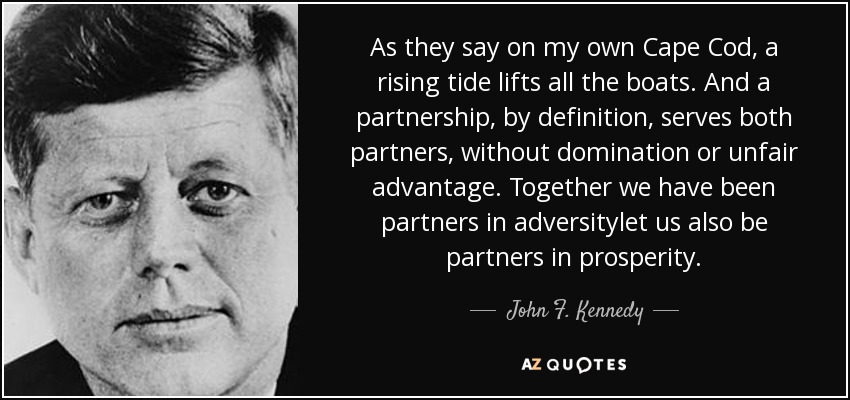
Craft Policy to Lift All Boats

Related image

“Ascribing the 2016 election to your opponent’s bigotry makes clear that [you think] the problem was not that Democrats didn’t do enough to deserve people’s votes, but that the people weren’t good enough to deserve Democrat’s governance…. One imagines that, sooner rather than later, even Democrats will come to suspect that denigrating people until they vote for you lacks a certain strategic plausibility.”

Our hometown paper’s editorial page provides thoughtful arguments on all sides of the most important questions we face. It has been doing this for a long time and we owe our thanks.

The page balances excellent analysis of local and national issues by the ABJ editorial staff with a carefully selected re-printing of commentary (and great political cartoons) from a wide variety of perspectives found in the best newspapers in the nation.

Recently, the page included a great piece by Helaine Olen, for instance, commenting on a recent study of education. The study shows that when we compare the graduation rates of kids with the same kindergarten test scores we observe that 70% of those from wealthy families graduate from college (and go on to successful careers) while only 30% of those from poor families do the same. This challenges my own deeply held belief in the value of a good education by pointing out that even if we did fix our educational system we would still have a lot of work left to do to get to that meritocracy promised land.

Much to my dismay the paper also printed commentaries by Christopher Richardson and Henry Olsen. Both are well below the paper’s normally very high standards. Both are thinly disguised apologists for brazenly and repeatedly doubling down on falsehoods. While that happens sometimes when a paper is dedicated to ensuring we are exposed to arguments from as many sides as possible, I hope this is not a reflection of new ownership putting their thumb on the scale. Neither link is provided here because neither is worth reading.

Today, the paper reprints a George Will column, a conservative from the Washington Post and a strong critic of the current president and his enablers like Olsen and Richardson. Will concludes with the statement I started with above (quoting another). Another good read. Thanks ABJ. We are fortunate to still have a strong local newspaper.

Saturday, May 25, 2019

When I was a stranger, you welcomed me.

We are usually in bed by 9. I know. But I say that to emphasize that when we went to the ER last night at 1am we were well beyond tired. We were also worried and frustrated, because Julie had severe & persistent stomach pains we could not explain.

In about two hours we were told surgery was required immediately. It went well and recovery will be complete. Jules will likely be able to come home tomorrow.

We were exhausted and confused, fish out of water facing a 'right now' decision about major surgery with potentially unwelcome consequences attending whichever path we chose. The kindness and competence of each and every person we encountered at Akron General was other-worldly. They were gracious and helpful, informative and respectful. They were on our side.

My favorite political scientist once said that democracy is a collaboration between experts and ignorant people. We all chose to be experts in one or two things and depend on others--pharmacists, and auto mechanics, bankers and nurses, security guards and farmers--to be experts in areas where we are ignorant. That is exactly how it worked for us last night and I am deeply grateful.

Saturday, May 18, 2019